I recently wrote a post for my church's ShelfLife website (our online theological book club if you will). Different members have written posts for each chapter of our current book, Tim Keller's The Reason for God. My post is about chapter 8, where he discusses different "proofs" or "clues" for God. You can find it here: watermarkblogs.org/shelflife/Wednesday, February 24, 2010
The Reason for God
I recently wrote a post for my church's ShelfLife website (our online theological book club if you will). Different members have written posts for each chapter of our current book, Tim Keller's The Reason for God. My post is about chapter 8, where he discusses different "proofs" or "clues" for God. You can find it here: watermarkblogs.org/shelflife/Sunday, February 7, 2010
What Does Sovereignty Mean?

In this post, I really just want to ask a question. Is God sovereign? And what does that mean? I know that most of us have strong opinions on this (even if we don’t realize we do). I definitely have my own opinions on the matter, but I want to hear what other people think. I think that there are difficult questions for either side, so don’t just give a yes or no, but try to answer (as best you can) the difficult questions surrounding your view. (Please include other questions if you can think of some that I overlooked).
If you do believe that God controls everything then (1) how do you still account for human responsibility and (2) how do you account for evil? Is God responsible for it?
If you do not believe that God controls everything then (1) is he truly omnipotent and omniscient (does he know the future?) and (2) is it possible that his ultimate plan could fail?
Keep it friendly :)
American Patriotism or Worship?

In ancient Rome the line between patriotism and worship was often non-existent. This was not so much a unity of state and religion as we conceive of it in Medieval European terms. It was not the religion that the emperor chose to support, but the popularly accepted way of understanding reality. Naturally, the state used these emotionally packed symbols and beliefs to encourage loyalty among it’s populace. Dead emperors were even sometimes declared to be gods.

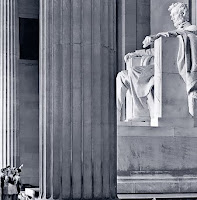
As I learn about the Roman popular cult, I naturally compare it to America. We pride ourselves on our separation of church and state (meaning that we have no state-sponsored religion), but where do we draw the line between patriotism and worship? When do our use of emotionally packed symbols and our glorification of past leaders and generations become cultic? It’s interesting by way of example to see what is engraved above ol’ Abes head in the Lincoln Memorial: “In this temple as in the hearts of the people for whom he saved the union the memory of Abraham Lincoln is enshrined forever.” Note the consistent use of religious language.
As Christians I believe we are called to submit to the state and to serve it when necessary. But we need to be sure to “give to Caesar the things that are Caesar’s, and to God the things that are God’s.” (Matt 22:21; Mark 12:17; Luke 20:25)
So far I’ve only really raised the question. I haven’t quite got the answer yet. Something to think about.
Friday, January 29, 2010
Yeshua (Jesus) in the Talmud
The Sanhedrin is, of course, the top Jewish legal court. In this text they have been explaining court procedure and defending their decisions where they have departed from their own rules. Keep in mind that this is not a Christian document (which would be bias towards Christ) but a Jewish one. The following quotation is taken from Sanhedrin Tractate 43b:

“On the eve of the Passover Yeshu [the Nazarean] was hanged. For forty days before the execution took place, a herald went forth and cried. ‘He is going forth to be stoned because he has practiced sorcery and enticed Israel to apostasy. Any who can say anything for his favor, let him come forward and plead on his behalf.’ But since nothing was brought forward in his favor he was hanged on the eve of Passover. ‘Ulla retorted: Do you suppose that he was one for whom a defense could be made? Was he not an enticer, concerning whom Scripture says, Neither shalt thou spare, neither shalt thou conceal him?”
We could spend forever discussing this passage; however, there are four things I’d like to note:
1. This is pretty strong non-Christian evidence for the historical existence of Jesus of Nazareth. This Jewish record corresponds in many ways to the Gospel accounts.
2. Jesus is accused of sorcery. This contradicts the modern tendency to call him a great teacher but claim that he never did anything supernatural. The Sanhedrin acknowledges that supernatural things were taking place, but just as the New Testament claims, they ascribed his work to the devil instead of God (see Matthew 12:24).
3. He is accused of apostasy. In other words, he wasn’t just teaching nice stuff. He was really stirring the waters. The Sanhedrin felt that he was changing their religion.
4. They quote Deut 13:8: “ Neither shalt thou spare, neither shalt thou conceal him,” as a justification for seeking capital punishment. This is in a larger section of the law dealing with what to do to a Jewish person who entices people to follow other gods (Deut 6-10). In other words, they felt like he was encouraging people to follow another god (Who do you suppose was the other god?). The law is very clear. You have to kill the person.
Just a quick qualification: I know that this is a touchy subject. If you perceive this at all as in anyway anti-semitic, I apologize. That is not at all my intent. This is just an interesting historical insight, getting the other side of the crucifixion story if you will.
Thursday, January 21, 2010
Cardinal Sadoleto vs John Calvin
In 1539, in the midst of the Protestant Reformation, Cardinal Jacopo Sadoleto sent a letter to the people of Geneva encouraging them to rejoin the Roman Catholic Church. The leaders of the city found themselves inadequate to supply the reply which they felt that the letter required. So, in order to provide the best answer possible, they sent for help. Calvin was not in Geneva at the time. He had been exiled from Geneva over a dispute with the city government, but when the need arose, the Genevois could think of no one better suited to the task than the great theologian. The result of these letters is one of the clearest presentations of the arguments on either side of the Reformation debate (the letters are published as A Reformation Debate, edited by John C. Olin).

Judging from his letter, Sadoleto seems to be either unaware of the key issues in the debate, unable to argue them, or unwilling to argue them. While his letter is profuse with confessions of love for the Genevois church, his arguments for their repentance are unsatisfying. He essentially gives an emotional appeal. His argument mostly consists of attacking the personal credibility of the reformers and encouraging the Genevois that they should at least try to save their own souls. He consistently assumes that the Roman Church is the true church. While he does briefly skirt the issue of justification by faith alone, he never engages the core issue of ecclesiology. Why is submission to the Pope necessary for membership in the church, and therefore, for salvation?
Calvin’s letter is quite polite as well (that’s one of the nice things about this conversation; it’s one of the most polite exchanges between Catholics and Protestants that I’ve seen from the 16th century). Calvin readily engages the ecclesiological question. He argues that the Roman hierarchy is not equivalent to the universal church, but that the Protestants actually have a greater similarity with the early church and a greater agreement with the Scriptures. He also provides ample examples of his arguments from the fathers and the Bible (something Sadoleto failed to do). One of the funniest things in the book is that in defense of his view of the Eucharist, Calvin does not offer any explanation of his own view but cheekily refers Sadoleto to read Augustine’s Epistle to Dardanus. The point is, Calvin’s theology is more true to the ancient traditions of the church than is the Cardinal’s, or even the Pope’s.
While more work has been done on both sides since then to develop these arguments, these letters provide a fascinating insight into the world of the 16th century when the reformation was born.
Tuesday, January 19, 2010
Beyond a Flannelgraph Understanding of the OT: David

Last semester I took a class which included a study of the history books in the Old Testament. This gave me another opportunity to study the life of David. I have always been fascinated by the accounts of King David, a man who has continued to be a pivotal character in the Bible, a foundational character for Jews, and the messianic heir of the Messiah for Christians. His theological significance is hard to fathom. And yet, as I read the accounts of David again, I was struck not by the theology which surrounds his history but by the man himself as his life unfolded in the raw uncertainty which characterizes everyone's lives.
What is Christianity without Christ?

I read so-called Christian theologians every now and then (like Bultmann or Harnack), and I have to wonder, "What makes you Christian." Please understand me, I'm not talking about their "Christianness" in terms of salvation or their classification as elect. I'm speaking in terms of religious categories. What I mean is that in order to fall under the broad (and it is very broad still) category of belonging to "Christianity" certain doctrines must be affirmed. One of the key requirements is a belief in Christ. The content of that belief must contain an acceptance of Christ's deity. There is hardly a more central tenant for Christianity. If one denies the deity of Christ (as many contemporary theologians are quick to do), how does one still qualify as a "Christian" as opposed to a "Buddhist," "Jew," "Taoist," or "Agnostic." Many of the other world religions hold that Christ was a great man, a moral teacher, an enlightened person worthy of emulation. Put another way, if one is willing to deny that Christ is God, how can one turn around and claim to be "One who believes that Christ is God." That is what the title "Christian" implies, a specific, meaningful confession of Christ.